

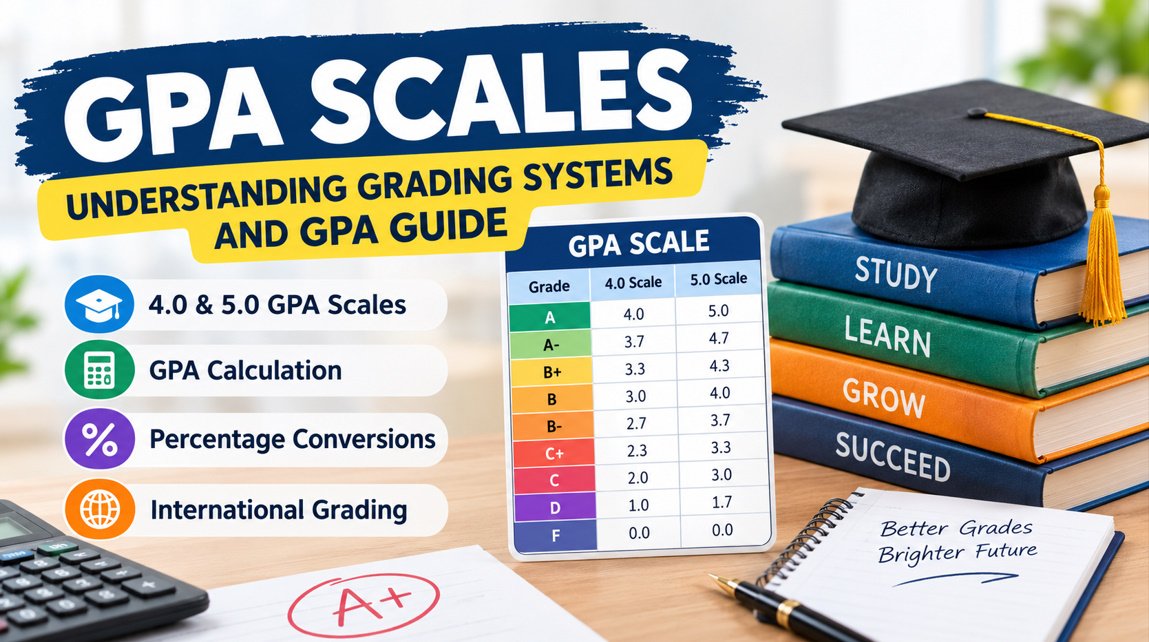
GPA scales help students understand their academic performance by converting course grades into numerical values. Whether you are in high school, college, or university, knowing how grade point average systems work can help you track your progress, set academic goals, and prepare for future educational opportunities. Different countries and institutions use different grading scales, so understanding their differences is essential when comparing grades or applying to international universities.
What Are GPA Scales?
A GPA scale is a grading system that converts academic grades into numerical values to measure a student’s performance. GPA stands for Grade Point Average, and it is commonly used by schools, colleges, and universities to summarize results across multiple subjects. Depending on the institution, grades may be represented on a 4.0, 5.0, 10.0, or another scale.
Students can use GPA scales to understand their academic standing, identify subjects that need improvement, and monitor progress throughout a semester or academic year. Although GPA is widely used in the United States, other countries may rely on percentages, letter grades, divisions, or different numerical systems.
- GPA means Grade Point Average.
- GPA scales convert grades into points.
- Different schools use different systems.
- A higher GPA usually indicates stronger performance.
- GPA can reflect semester or cumulative results.
- Letter grades may correspond to GPA points.
- Course credits can affect GPA calculations.
- Official grading policies vary by institution.
Understanding the 4.0 GPA Scale
The 4.0 GPA scale is one of the most widely recognized grading systems in the United States. Under a typical unweighted system, an A may equal 4.0 points, a B 3.0, a C 2.0, a D 1.0, and an F 0.0. Some schools also assign intermediate values for plus and minus grades.
This scale provides a straightforward way to summarize academic achievement across different subjects. However, the exact conversion between percentages, letter grades, and GPA points depends on the school’s grading policy. A percentage of 90, for example, may correspond to an A at one institution and a different letter grade at another.
- A commonly represents 4.0 points.
- B commonly represents 3.0 points.
- C commonly represents 2.0 points.
- D commonly represents 1.0 point.
- F commonly represents 0.0 points.
- A 4.0 is the standard unweighted maximum.
- Plus and minus grades may change point values.
- School policies determine exact grade conversions.
Typical 4.0 GPA scale
| Letter grade | GPA points | General meaning |
| A | 4.0 | Excellent |
| B | 3.0 | Good |
| C | 2.0 | Satisfactory |
| D | 1.0 | Low passing grade |
| F | 0.0 | Failing |
Illustrative unweighted scale. Individual schools may use different grading rules.
What Is a 5.0 GPA Scale?
A 5.0 GPA scale is commonly associated with weighted grading systems in which advanced courses receive additional grade points. For example, an honors, Advanced Placement, or International Baccalaureate course may receive more points than a standard course with the same letter grade. This approach recognizes the increased academic difficulty of certain classes.
A GPA above 4.0 may therefore be possible at a school that uses weighted grades. However, a 5.0 scale does not automatically mean every student can earn 5.0 points in every class. The maximum depends on the course type, grade, and institutional policy. Students should check their school’s official weighted GPA calculation rules.
- Weighted grading may reward advanced coursework.
- Standard classes may use a 4.0 maximum.
- Advanced courses may receive extra points.
- Honors courses may have different weighting.
- AP courses may receive additional grade points.
- IB courses may receive additional grade points.
- A GPA above 4.0 can be possible.
- Weighting policies differ between schools.
Understanding the 10.0 GPA Scale
The 10.0 GPA scale is used by some educational institutions, particularly in systems where academic results are reported on a ten-point basis. Depending on the country and institution, students may receive grade points directly or have marks converted into a numerical average. A higher value generally indicates stronger academic performance.
It is important to distinguish a ten-point GPA from a percentage score. A GPA of 8.0 out of 10 does not automatically mean that a student earned exactly 80% in every subject. Institutions may use grade bands, credit weighting, or specific conversion formulas. Always consult the official grading scheme before comparing results.
- The maximum may be 10.0.
- Higher points generally indicate better performance.
- Institutions define their own grade boundaries.
- Some systems use direct grade-point averages.
- Others convert marks into grade points.
- Subject credits may influence the result.
- Percentage scores and GPA are not identical.
- Official conversion rules should be checked.
How to Calculate Your GPA
Calculating your GPA involves converting your course grades into grade points and averaging them according to the credits assigned to each course. In many colleges and universities, courses with more credit hours have a greater influence on the final GPA. This method is known as a credit-weighted grade point average.
To calculate GPA, multiply each course’s grade points by its credit hours, add the resulting values, and divide the total by the number of credit hours. For example, if you earn 4.0 points in a three-credit course and 3.0 points in a two-credit course, your GPA is 3.6.
- Collect your grades for each course.
- Identify the grade points earned.
- Find each course’s credit hours.
- Multiply grade points by credit hours.
- Add all weighted grade points.
- Calculate total credit hours.
- Divide weighted points by total credits.
- Check the result against your school’s policy.
GPA calculation formula:
\[ \text{GPA}=\frac{\sum(\text{Grade Points}\times\text{Credit Hours})}{\sum\text{Credit Hours}} \]
Example calculation:
| Course | Grade points | Credit hours | Weighted points |
| English | 4.0 | 3 | 12.0 |
| Mathematics | 3.0 | 2 | 6.0 |
| Science | 3.5 | 3 | 10.5 |
| Total | 8 | 28.5 |
GPA = 28.5 ÷ 8 = 3.56 (rounded to two decimal places).
Difference Between GPA and CGPA
GPA and CGPA are closely related academic measurements, but they represent different periods of study. GPA usually refers to the grade point average earned during a particular semester or term. It allows students to evaluate their performance in a specific period and determine whether their academic results are improving.
CGPA stands for Cumulative Grade Point Average. It measures academic performance across multiple semesters or the entire programme, depending on institutional rules. A student may earn a high GPA in one semester but have a lower CGPA because of earlier results. Understanding both measurements helps students monitor short-term progress and overall achievement.
- GPA commonly measures one semester.
- CGPA measures performance across multiple periods.
- GPA can change each semester.
- CGPA reflects accumulated academic results.
- Both may use the same numerical scale.
- Credit hours can affect both calculations.
- Repeated-course policies may influence CGPA.
- Graduation requirements depend on the institution.
Comparing GPA Scales Around the World
GPA scales differ across countries because educational institutions use different methods to assess academic performance. American universities commonly use a 4.0 scale, while some institutions in other countries use a 10.0 scale or percentage-based grading. Other systems rely on letter grades, classifications, or national grading frameworks.
When applying to an international university, students should not assume that their GPA can be converted using a simple mathematical formula. A 3.5 GPA on a 4.0 scale and a 7.0 GPA on a 10.0 scale may look proportionally similar, but the underlying grading standards may differ. Admissions offices often evaluate transcripts using their own requirements.
- The United States commonly uses a 4.0 scale.
- Some institutions use a 5.0 weighted scale.
- Some countries use a 10.0 scale.
- Percentage-based grading is common internationally.
- Letter-grade systems vary by institution.
- Equivalent grades may use different boundaries.
- International admissions may require credential evaluation.
- Official conversion rules should guide comparisons.
GPA scale comparison
| Scale | Typical use | Important detail |
| 4.0 | Many US institutions and other universities | Often used for unweighted GPA |
| 5.0 | Some weighted or institution-specific systems | Maximum depends on the rules |
| 10.0 | Some international institutions | Grade boundaries vary |
| Percentage | Schools and universities worldwide | Not automatically equivalent to GPA |
These are general examples, not universal countrywide rules.
How to Improve Your GPA and Choose the Right Scale
Improving your GPA starts with understanding your current grades, course requirements, and academic goals. Review your transcript to identify subjects where your performance is weaker, then create a realistic study schedule. Consistent revision, timely assignment submission, active participation, and seeking help from teachers can make a meaningful difference over time.
Choosing the right GPA scale is equally important when comparing academic records or preparing university applications. Always use the grading system specified by your school or university rather than selecting a conversion method simply because it produces a higher result. Accurate calculations and a clear understanding of academic requirements help you make informed decisions about your education.
- Review your current academic transcript.
- Set realistic semester GPA targets.
- Create a consistent study schedule.
- Practise difficult topics regularly.
- Submit assignments before deadlines.
- Seek feedback from instructors.
- Use your institution’s official GPA calculator.
- Confirm conversion requirements before applying abroad.
Frequently Asked Questions About GPA Scales
What is a good GPA on a 4.0 scale?
A GPA of 3.0 is often considered a solid academic average, while 3.5 or higher generally indicates stronger performance. However, what counts as a good GPA depends on the institution, programme, scholarship, and admission requirements.
Is a 3.5 GPA the same as 87.5%?
Not necessarily. Multiplying a 3.5 GPA by 25 produces 87.5 as a mathematical estimate, but this does not establish an official percentage equivalent. Grade boundaries and conversion rules vary by institution.
Can you have a GPA higher than 4.0?
Yes. Some high schools use weighted GPA systems that award additional points for advanced courses. Whether a GPA can exceed 4.0 depends on the school’s weighting rules.
Which GPA scale is the best?
No single GPA scale is best for every student or institution. The appropriate scale is the one officially used by your school or university and accepted by the organization evaluating your academic record.
Conclusion
GPA scales provide a practical way to measure, compare, and understand academic performance. From the commonly used 4.0 scale to 5.0 weighted systems and 10.0 grading frameworks, each system follows its own rules. Learning how GPA is calculated, understanding the difference between GPA and CGPA, and checking official grade conversions can help students plan their studies and prepare for future opportunities. Always consult your institution’s grading policy for accurate results.